

Launch in Five Days
Your students try taking responsibility for their own project and continuing when their first idea does not work. Over five days, they discover how their decisions stand up to real customers' responses. They gain experience to draw on in future projects at school and beyond.
- Students test a problem through conversations with people outside school.
- They create a prototype and try trial sales.
- They defend their project and examine teamwork.

- Who it is for
- Secondary-school students
- Scope
- 5 × 6 hours
- Participants
- By agreement
- Price
- On request
A team project grounded in personal experience
In later lessons, you can draw on teams' decisions, customers' responses and the final reflection. Students can then see what they manage more independently in a new task and where they still need support.
Experience with a prototype and sales
Students develop their view of the customer, prepare a prototype and try selling it. They bring costs, revenue, price and actual field feedback into their proposal. They see what their decisions mean in practice and what needs to change.
Explained decisions and shared reflection
They present what they learned and why they chose a particular solution to entrepreneurs. With guides, they examine collaboration, their own contribution and what they would do differently next time. They leave with a next step grounded in their own experience.
Five-day programme
Each day brings the idea closer to reality
The programme combines teamwork, field interviews, consultations and creation. A practising expert working in tandem with an educator helps teams evaluate findings and use them to adjust their next steps.
-
A team, a problem and first questions
Teams choose a problem and customer, record assumptions in the VPC and consult on their testing plan.
Day 1
-
Field interviews and solution design
Interviews test the problem, need and initial solution and price; teams present their findings to others.
Day 2
-
What it costs and how to offer it
Using Lean Canvas, they consider costs, revenue and price, and prepare promotion and trial sales.
Day 3
-
Prototype and trial sales
They create and test a prototype, try selling it and prepare a presentation with feedback.
Day 4
-
The big day — defending the project and reflecting
They defend their project before entrepreneurs and reflect together on results, collaboration and individual contributions.
Day 5
What students will learn
They use the tools on their own project, returning regularly to what helped them decide and what they need to test differently.
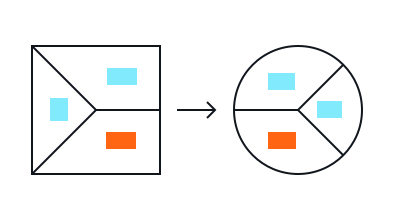
Value Proposition Canvas
They compare the problem and proposed offer with customer needs.
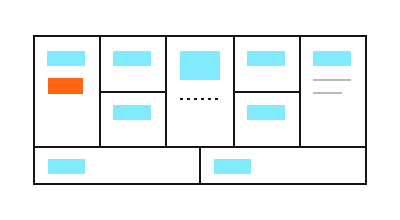
Lean Canvas
They connect the solution, price, costs, revenue and route to customers.
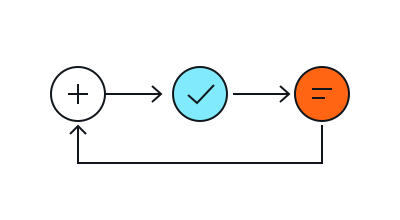
Prototype and trial sales
They try the offer in practice and adjust it based on real feedback.
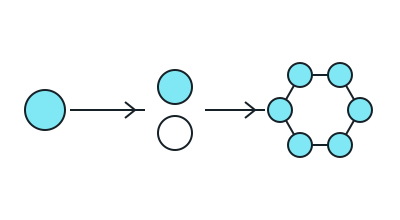
Presentation and reflection
They explain their decisions and choose what to do differently next time.
Arrangements to suit your school
The course is for secondary-school students. Guides lead project work, consultations and reflection; we agree specific terms with your school.
Scope
5 × 6 hours
Five days of an in-person programme form one connected experience, from preparing tests to defending the project and reflecting.
Your involvement
Together, we clarify the group, date, facilities, fieldwork conditions and format of the final presentation day.
Price
By agreement
You receive a specific price and organisational terms in the offer for your school. You confirm the booking only after approving the proposal.
From previous courses
A participant's experience
“It was a good insight into the business world. If I ever go into this, I will definitely use some of what I learned.”
Anonymous participant feedback, original Učitelé z Marsu offer (translated from Czech)
Launch in 5 Days! continues under Adaptivio. It draws on experience of guiding student teams, which we also bring into preparing teachers for the guide's role.
Questions before booking
Do students need a business idea or experience?
They do not need a prepared project. They start from scratch: on day one, teams choose a problem and customer and prepare a testing approach with guides. They work through subsequent steps during the programme.
Is the programme meaningful for students who do not want to start a business?
Yes. On their own project, they try collaboration, conversations with people, decisions based on findings and explaining their approach. These experiences are also useful in further study and employment.
Why does the programme need five days?
The days build on one another: interviews lead to a proposed solution that the team develops, tests and finally defends. The duration is 5 × 6 hours; we agree specific dates with the school.
What does our school need to prepare?
We clarify the student group, dates, facilities, fieldwork conditions and final presentation format together beforehand. Guides lead project work, consultations and reflection; we agree specific organisational responsibilities while preparing the offer.
Will students work outside the school too?
The programme includes conversations with real potential customers and field testing. Conditions for this work must be agreed with the school in advance, including where and how it will take place.
What if the sale does not succeed?
The team examines the customer, solution, price and its approach. Guides help choose the next step from this experience. The purpose is learning: even a first successful sale alone does not prove a business is viable.
Does the project have to be finished and successful at the end?
The outcome is a prototype and experience of testing it, not a finished company. In the final presentation before entrepreneurs, students explain their decisions, results and what they learned from collaboration and feedback.
Can we build on the experience in our own teaching?
Yes. You can return to prototypes, teams' decisions and the final reflection, or use the experience in a new project. For support in guiding this work yourself, explore the separate teacher courses in the related content below.