

Mentoring and Knowledge Sharing
Turn your expertise into support that helps colleagues learn and gradually work independently. Try practical tasks, feedback and reflection on results. Prepare a first approach to sharing a specific skill from your own work.
- Find your role in sharing expertise and better understand colleagues.
- Examine how tasks, collaboration and reflection support learning.
- Prepare to use the methods when sharing your expertise.

- Who it is for
- Practitioners
- Scope
- 4 hours
- Participants
- By agreement
- Price
- On request
Who you will work with
You will work in an open group of people from different backgrounds. A company can also book a separate workshop for its colleagues; please tell us which option you are looking for.
Help colleagues learn what you know.
Find your role in helping others learn
Using Ikigai, connect what you know and enjoy with where you can be useful to colleagues. Explore their interests, abilities and opportunities through the same lens.
Prepare one concrete way to share a skill
Choose a skill from your practice and think through a task, your colleague's involvement, feedback and reflection on what they learned.
First you learn. Then you examine how.
As in Teacher as a Guide, we connect experiencing a method with examining how it was led. Here, we relate everything to colleagues' learning in professional practice.
-
Discover your resources and understand others
Using Ikigai, explore your interests, abilities and contribution when sharing expertise. Through conversation, discover colleagues' perspectives and notice what helps you think.
-
Examine the methods used
Using the shared work, examine how the guide set tasks, involved participants and led feedback and reflection. Identify how the approaches responded to different needs.
-
Bring them to your own colleagues
Choose a specific skill you need to share and prepare the first use of a method in your work.
Tools and skills
What you will try
We choose methods already used in teacher preparation. Ikigai helps you find your own role and understand others; you experience and examine further approaches for sharing expertise.

Ikigai
Connect your interests and abilities with others' needs and opportunities to contribute; use the same perspective to explore what might be meaningful to colleagues you teach.
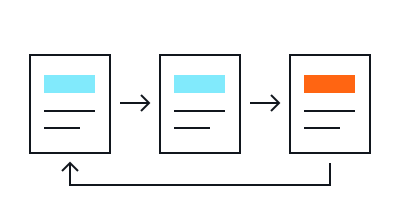
A problem-solving task
Experience searching for a solution and design a task through which a colleague can learn your skill by doing.
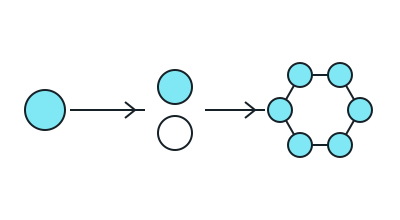
Think–Pair–Share
Try individual thinking, comparison in pairs and shared discussion to give everyone space.

Feedback
Practise feedback on a concrete attempt that helps a colleague improve their next piece of work.
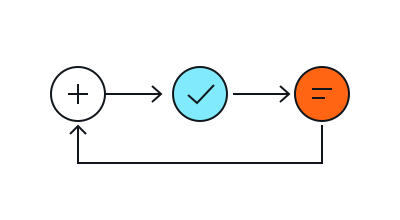
Guided reflection
Use questions to help a colleague identify what they learned, how they got there and what they will use next time.
The four-hour workshop offers a first experience and ideas for your practice. You will continue developing their use as you work with people.
Four hours for sharing your expertise
For experienced colleagues, specialists and internal trainers who help others master their work. Enquire for yourself or a group of experts from your company. We agree the date, venue, price and group size before confirmation.
Your preparation
Bring an example of what you need to teach a colleague. You do not need a teaching qualification or a finished presentation.
What Adaptivio provides
The guide leads shared activities, analysis of methods and reflection. They help you think through transfer into your practice; any further development is agreed separately.
Questions before booking
Do I have to be a manager or trainer?
No. The workshop also suits a specialist others turn to for advice or a colleague onboarding new staff. What matters is a need to pass on something you know.
Will we learn the same methods as teachers?
Yes. We work with Ikigai, problem-solving tasks, Think–Pair–Share, feedback and reflection. We relate them to your expert role and adult learning at work.
Why is Ikigai part of the workshop?
It helps you find purpose in teaching others and identify what you can offer. It also turns attention to colleagues' interests, abilities and opportunities: what is meaningful for them to develop and what they can build on.
Will I mainly learn to present better?
The focus is your colleague's learning: what they try themselves, how you help and what they can do as a result. You prepare a method for a specific skill you need to share.
How does feedback differ from reflection?
Feedback helps improve specific work. Reflection helps a person identify their own experience and learning. In the workshop, you experience and examine both.
Can I join alone, or is the workshop only for companies?
You can enquire as an individual or for a group of colleagues. We clarify the participation format, date, price and terms before confirmation.